When a heavy equipment manufacturer required a new production test solution for a domain controller ECU, the objective was clear: deliver a system capable of supporting automation, expanding pneumatic control, and creating higher throughput without sacrificing precision.
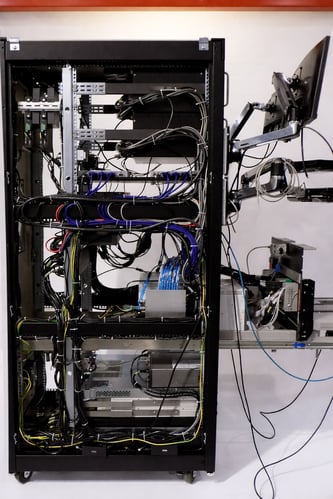
Ball Systems engineered and built a custom dual-PC test cabinet and robotics-ready fixture designed to validate domain controller modules efficiently within an automated production environment.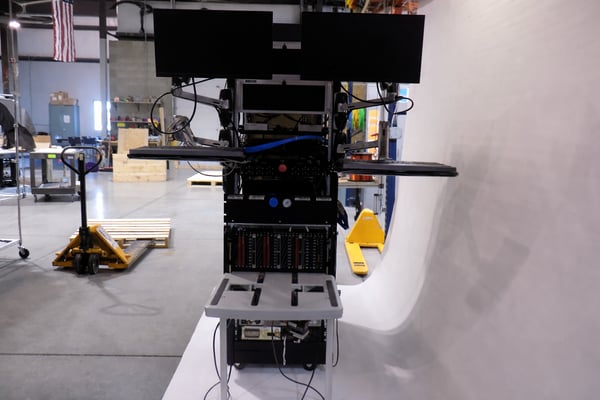
The domain controller functions as a secure access point within heavy equipment, enabling operators and systems to access job-site data networks. Because these ECUs manage critical communication and operational data, production validation must be accurate, repeatable, and automation-compatible. The new system needed to:
This was more than a standard build-to-print project. It required mechanical refinement, electrical integration, and disciplined execution.
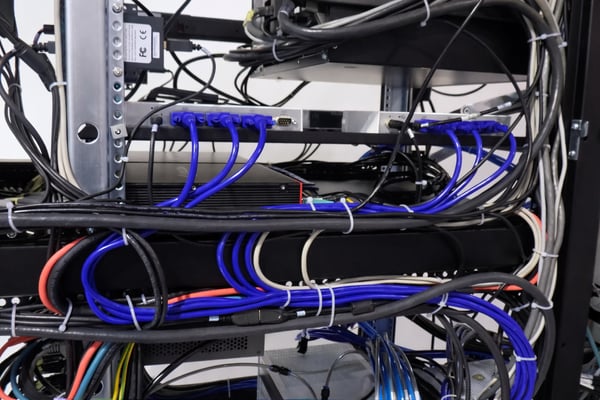
Ball Systems delivered a custom dual-PC production test platform integrating high-density mass interconnect and digitally controlled pneumatic actuation to support automated, repeatable validation.
Within the tester, digital I/O signals control compressed air systems that actuate mechanical components, allowing the platform to clamp, engage, and release the device under test with precise timing and consistent contact force. This synchronized sequencing ensures reliable data capture throughout each cycle.
The architecture incorporated National Instruments PXI chassis components, including high-speed oscilloscopes (PXIe-5122) and PXIe-2532B relay matrices, interconnected through a 25-slot VPC mass interconnect receiver to manage complex signal routing.
Vector CANtech communication modules and CANoe software enabled network validation over CAN and Ethernet, while a Keyence CMOS barcode scanner provided unit-level traceability. Power was supplied by an Agilent 60V/25A/1500W modular power supply, delivering stable output under demanding conditions.
Integrating this range of instrumentation, communication interfaces, traceability hardware, and industrial power systems into a cohesive platform required precise coordination across disciplines.

The most technically demanding portion of the project was the fixture itself. Unlike traditional setups where pogo blocks are integrated into the DUT interface, this system required the product to move to the pogo blocks, a decision driven by robotic automation goals. Robotic arms load ECUs into position, requiring precise alignment and reliable pneumatic engagement.
The expanded pneumatic system controls engagement and disengagement using air-actuated mechanisms. Digital I/O modules synchronize movement with proximity sensors and test sequencing to ensure accurate, repeatable connections.
The result is a fixture that is automation-ready, adjustable, serviceable, and built for high-cycle production use.
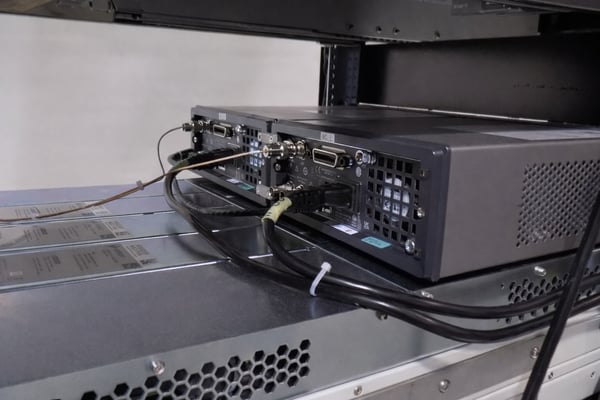
Instrumentation modules collect, route, and convert signals from the ECU under test, while digital controls coordinate fixture engagement and test execution.
The full test sequence integrates:
Every subsystem was engineered for long-term production stability and repeatable performance.
As requirements evolved, Ball Systems adapted the architecture to align with updated production goals. The modular design allowed the customer to scale with additional units rather than redesigning the system from scratch. Ball Systems kept the lines of communication open from start to finish to ensure all parties were aligned as the project moved through our workshop.
The Outcome
The customer received a robotics-ready, dual-PC production test system capable of validating domain controller ECUs with improved throughput and automation compatibility. Manufacturing teams gain faster cycle times, while engineering benefits from repeatable, production-grade validation.
This project reflects Ball Systems’ core strengths: precision build-to-print execution, selective design refinement, integration of mechanical and electrical systems, supported by transparent collaboration throughout evolving requirements. Ball Systems builds manufacturing-ready electrical test platforms that integrate seamlessly into automated production environments without adding unnecessary complexity
Ball Systems creates, develops, and delivers custom test systems and produces comprehensive build-to-print systems for companies that craft or manufacture critical electronic or electromechanical components for aerospace and defense, automotive, and consumer appliance applications.