Every complex piece of equipment eventually needs to talk to a diagnostic tool. Whether it's an aircraft, an industrial control cabinet, or a piece of automated test equipment, technicians need a fast, reliable way to pull voltage, current, resistance, capacitance, and frequency readings without tearing the system apart. That connection almost always comes down to one deceptively simple component: a cable. At Ball Systems, we've built our build-to-print cable manufacturing practice around getting that connection exactly right, every time.
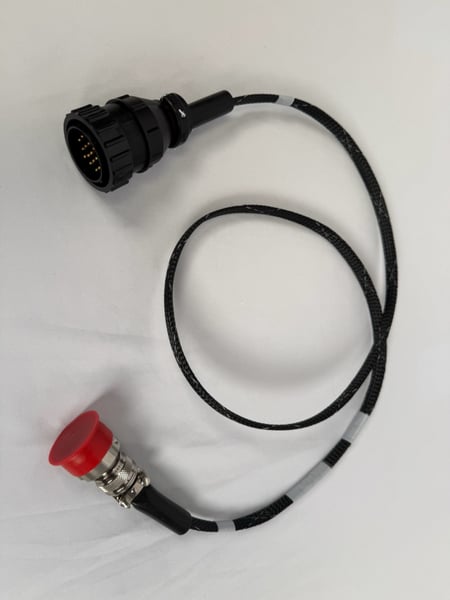
A customer in the aerospace and defense space needed a durable cable harness to link a technician's diagnostic computer, functioning as a digital multimeter (DMM) reader, to a complex on-platform system so maintenance crews could pull fault codes and performance data in the field and in test environments. The requirement was straightforward to state and unforgiving to execute: the cable had to mate perfectly with mixed connector types, survive repeated field handling, and deliver clean signal integrity for voltage, current, resistance, capacitance, and frequency measurements used in flight and flight-simulated diagnostic testing.
Because the finished assembly would be relied on to produce trustworthy diagnostic data, there was no tolerance for shortcuts on connector selection, wire specification, or documentation.
|
|
Our engineering and operations teams approached the DMM interface cable the same way we approach every custom cable assembly project: start from the customer's print and BOM, then apply decades of wire harness manufacturing experience to make sure the finished product performs in the real world, not just on paper.
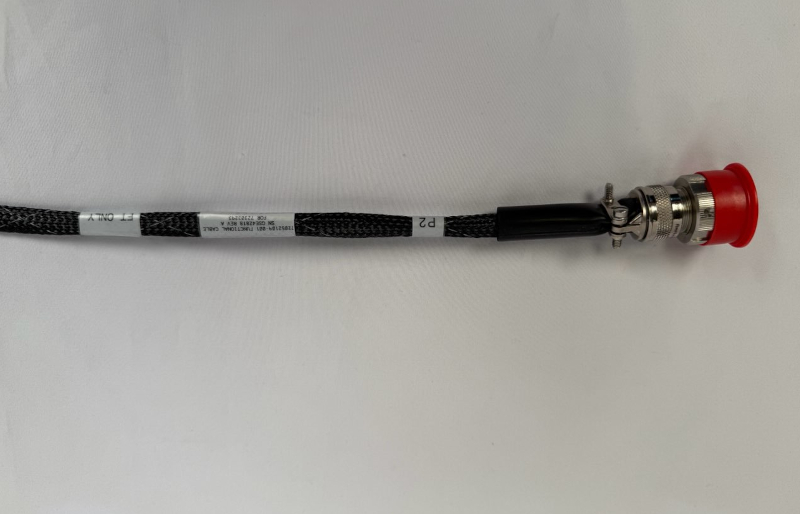
The assembly pairs a multi-pin, MIL-SPEC-style circular connector on one end with a high-density D-subminiature connector on the other, joined by high-temperature Teflon-insulated wire built to M16878 specification. Every conductor, sleeve, and label on the harness is selected and sourced against the customer's approved parts list, with long-lead and stock-availability items tracked from quote through kitting so a single missing connector pin never holds up a build.
Once wired, every cable assembly moves through a documented mechanical inspection: connector fit and shell condition, weld and joint integrity where applicable, and a scratch-free finish check, each one logged with date and inspector initials against the job's acceptance test procedure (ATP). Because these interface cables are often used in flight-representative diagnostic testing, Ball Systems fills out ATPs to the standards our aerospace customers require, so the data a technician pulls off the DMM reader can be trusted.
This level of traceability, sourcing detail down to the individual pin and sleeve, inspection sign-off, and job-numbered documentation, is what separates a one-off wiring job from a build-to-print cable manufacturing partner that an aerospace program can standardize on.
A DMM interface cable rarely lives on its own. It's one link in a larger diagnostic or test equipment ecosystem: the technician's laptop or handheld meter on one end, and a fielded system, test stand, or ground support equipment (GSE) fixture on the other. Ball Systems designs and builds toward that bigger picture. Our Build-to-Print services exist alongside Design Engineering, Electronics Test, and Test Services groups under one roof, so a cable like this one is built with an understanding of the system it plugs into, not in isolation.
That systems-level perspective is a big part of why customers come back to Ball Systems for repeat cable orders rather than treating each harness as a one-time purchase. The same engineering rigor that goes into a full automated test system, connector selection, signal integrity, documentation, and inspection, scales down cleanly to a single interface cable and scales back up just as cleanly when that cable needs to become part of a larger GSE or test-stand build.

Ball Systems creates, develops, and delivers custom test systems and produces comprehensive build-to-print systems for companies that craft or manufacture critical electronic or electromechanical components for aerospace and defense, automotive, and consumer appliance applications.