
Safety is paramount in the automotive electronics realm. When you’re validating safety-critical systems—whether it’s airbag controllers, sensor networks, braking subsystems, or advanced driver assistance electronics—your test platform must be repeatable, scalable, serviceable, and rock-solid reliable.
That’s exactly the challenge Ball Systems took on when an automotive manufacturer required a build-to-print Safety PXI Endpoint Rack designed to streamline functional testing for safety electronics.
The result was a modular endpoint test rack engineered for long-term production use, built around one of the most powerful automated test architectures available today: National Instruments’ PXI.
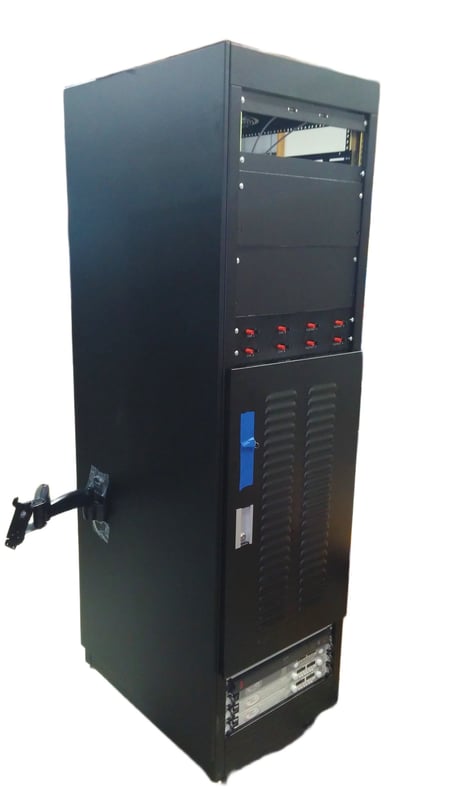 The side-profile image shows a service-friendly enclosure built for long-term reliability on the production floor.
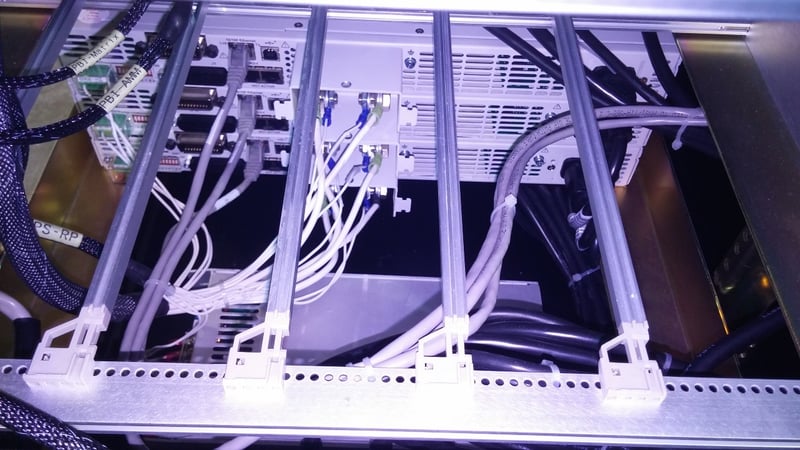
Interior cabinet photos highlight precise cable and wire routing that preserves signal integrity and simplifies maintenance.
Customer needs were clear from the start. They required a test system capable of supporting high-volume testing while remaining adaptable as test requirements evolved. A key requirement was a modular I/O strategy capable of scaling up to 80 channels of I/O, configurable in 20-I/O increments. This approach enabled the manufacturer to add capability over time without redesigning the entire rack, reducing downtime and protecting the long-term investment.
This project wasn’t just about building a rack. It was about creating a repeatable test foundation that could evolve with new product generations and changing validation standards.
At the heart of the system is a National Instruments PXI chassis. Specifically the NI PXIe-1084 18-slot PXI chassis. PXI is a modular instrumentation standard designed for automated test environments. In this rack, NI PXI acts as the system’s measurement backbone and high-speed data acquisition hub, while also serving as the centralized control interface. It provides timing and synchronization across multiple instrumentation modules and supports modular expansion as future test needs change.
Unlike traditional standalone bench equipment, PXI allows instrumentation modules to operate inside a unified chassis with a high-speed backplane. That means faster measurements, cleaner integration, and easier expansion as test requirements change. For a production-floor automotive validation system, PXI offers something manufacturers can’t compromise on: precision and consistency at scale.
The rack was built to print as a complete automated test system, including full integration of hardware, wiring, and documentation deliverables such as the bill of materials and wiring diagrams.
Ball Systems engineered the rack as a complete, functional endpoint platform designed for reliability and serviceability. The finished system integrates National Instruments PXI hardware, Pickering switching, and supporting components from Vector, Agilent, Tripp Lite, and Super Logics. Together, these technologies form a unified test platform capable of supportingsafety electronics validation with speed and confidence.
The mechanical platform was built around an industrial rack cabinet to ensure the depth and mounting capacity required for high-power and high-density instrumentation systems.
The side-profile image shows a service-friendly enclosure built for long-term reliability on the production floor. Interior cabinet photos highlight precise cable and wire routing that preserves signal integrity and simplifies maintenance.
The enclosure design shows exactly what Ball Systems builds best: a robust, production-ready system engineered for long-term use.
The rack uses a Virginia Panel mass interconnect system to connect PXI instrumentation and rack subsystems to the product under test. This integration enables rapid connection and disconnect while ensuring repeatable pin alignment. It also reduces wiring errors and creates standardized test fixture interfaces. For automotive manufacturers, this dramatically improves operational efficiency by minimizing setup time and simplifying test changeovers.
Beyond PXI instrumentation, the rack integrates additional test systems commonly required for functional safety validation. These include a Tektronix oscilloscope mounted in-rack, electronic loads installed via Chroma mainframe modules, and an industrial PC running Windows 10 or higher. The rack also includes uninterruptible power supply protection to safeguard critical test operations.
Power delivery is supported by three high-capacity programmable power supplies capable of at least 80V and 50A, which is essential for automotive power electronics validation environments.
The finished Safety PXI Endpoint Rack delivered exactly what the customer needed. It provides a repeatable build-to-print system design, modular scalability up to 80 I/O channels in 20-channel increments, and a layout built for service access and production-floor durability.
It also offers cleaner subsystem organization, improved accessibility, and an expandable PXI instrumentation backbone that supportsfuture validation needs. With its service-friendly wiring layout and durableconstruction, the rack provides a reliable foundation for high-volume testoperations.
This wasn’t just a rack shipment. It was a standardized test platform designed to enable ongoing validation, rapid updates, and long-term deployment across safety-critical automotive programs.
Ball Systems delivered a platform engineered for precision, consistency, and scalable performance, powered by the NI PXI ecosystem and integrated with best-in-class switching and supporting instrumentation. The rack was shipped to the automotive customer as a durable foundation for high-reliability manufacturing validation.
When you need precision, consistency, and scalable test capability, you need a partner who understands the stakes.

Ball Systems creates, develops, and delivers custom test systems and produces comprehensive build-to-print systems for companies that craft or manufacture critical electronic or electromechanical components for aerospace and defense, automotive, and consumer appliance applications.