

Semiconductors are at the core of renewable energy systems and must meet increasingly demanding performance requirements. When a leading solar technology company developed a next-generation mixed-signal ASIC for its micro-inverter platform, the complexity of the device required a new approach to silicon validation. Traditional bench-based testing methods were too slow, manual, and fragmented to support aggressive deadlines and rapid design iteration.
Ball Systems was asked to design and deliver a fully automated characterization platform capable of validating a highly integrated mixed-signal ASIC under real-world operating conditions. The goals were clear: dramatically reduce characterization time, increase measurement coverage, improve data integrity, and enable faster design decisions between silicon revisions.
A solar ASIC is a custom chip designed to manage how a solar panel system converts and controls power efficiently and safely. It monitors performance, adjusts to changing sunlight conditions, communicates system data, and protects the equipment to ensure reliable long-term operation.
In this instance, the ASIC integrated multiple precision analog and digital subsystems, including three 12-bit ADCs, analog and digital LDO regulators, multiplexers, a PLL clock generator, and an embedded processor with memory. Each functional block had to be characterized across numerous configurations, supply conditions, and temperature corners. In total, the device required validation across 27 configuration modes, three voltage conditions, and three temperature ranges, resulting in more than 1,000 unique test permutations.
Under traditional laboratory methods, this level of validation would require weeks per device, significant floor space, and multiple bench instruments operating in parallel. But more importantly, the time lag between receiving silicon and generating actionable performance data risked missing the next deadline window, which could’ve meant adding months to the development cycle. The customer needed a faster, more scalable solution.
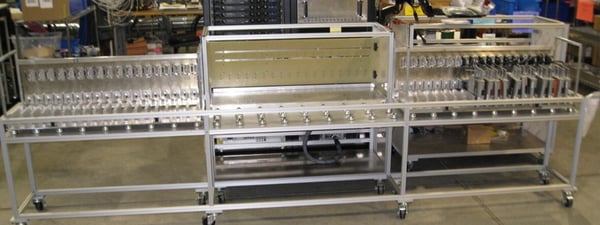
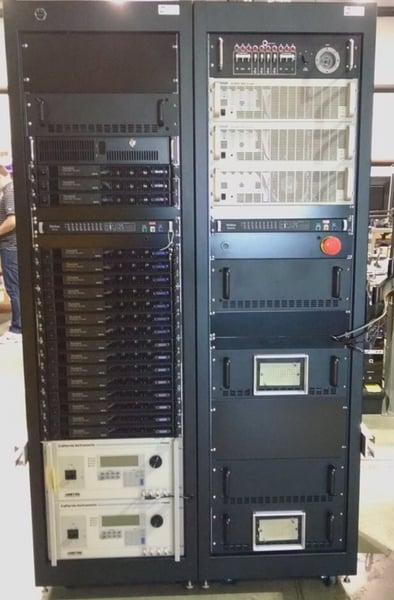
Ball Systems created a fully integrated automated measurement platform built on a high-performance National Instruments (NI) PXI modular instrumentation architecture. At the core of the system was an 18-slot PXI chassis populated with precision instrumentation selected specifically for mixed-signal characterization.
Signal generation for ADC dynamic testing was provided by the NI PXIe-5451 16-bit, 400 MS/s arbitrary waveform generator, delivering the spectral purity and phase coherence required for FFT-based ENOB, SFDR, and SNDR analysis. High-speed digital acquisition was achieved using three synchronized NI PXIe-6556 digital waveform generator/analyzers, enabling deterministic capture of the ASIC’s 12-bit ADC data bus operating at 25 MHz. Precision voltage, current, and resistance measurements were taken using the NI PXI-4071 7½-digit digital multimeter, while high-speed analog waveform capture leveraged the NI PXI-5124 digitizer. Additional system control and biasing functions were managed through NI PXI-6733 analog outputs and PXI switching modules, all tightly integrated within the PXI backplane.
A critical technical hurdle involved reconstructing the high-speed ADC output bus distributed across multiple package pins. By using the PXI system’s precise timing and synchronization features, Ball Systems was able to sync all three PXIe-6556 modules to operate together as one.
This precise, predictable timing control eliminated bit skew and enabled reliable mixed-signal correlation between stimulus and response, unlocking accurate dynamic characterization at full operating speed.
Unlike traditional rack-and-stack instrumentation, the NI PXI platform provided tight timing control, integrated triggering, reduced system footprint, and lower overall cost while maintaining high measurement fidelity. The result was a cohesive, scalable architecture capable of executing complex test sequences automatically and repeatedly.

The measurement system combined NI LabVIEW and NI TestStand to create a flexible, extendable software framework aligned with modern semiconductor development workflows. LabVIEW was used to develop instrument drivers, measurement algorithms, waveform analysis routines, and post-processing functions. Its modular structure allowed rapid development of ADC linear measurements, FFT-based spectral analysis, LDO regulation testing, and temperature-dependent bias characterization. A streamlined graphical interface provided clear operator interaction without unnecessary complexity.
TestStand managed configuration sequencing, voltage and temperature permutations, and automated data logging. Because the characterization system was developed in parallel with ongoing ASIC revisions, this layered architecture allowed parameters and test conditions to be modified quickly without rewriting core measurement code.
High-resolution data sets, including multi-million-sample INL and DNL captures, were stored using an efficient binary format to preserve precision while maintaining manageable file sizes. The platform produced consistent, structured data suitable not only for validation but also for deeper statistical analysis and long-term reliability evaluation.
The impact of automation was immediate. Characterization time was reduced from weeks per device to just hours. The synchronized PXI system delivered consistent, repeatable measurement coverage across ADC performance, LDO behavior, power supply rejection, bias stability, and dynamic signal integrity, all within a single integrated platform.
During first silicon evaluation, the automated test suite uncovered a critical issue that would have otherwise gone undetected until later validation stages. Because the system delivered comprehensive data quickly, the customer secured a foundry respin before the next scheduled tapeout window, eliminating an entire design iteration. The time savings alone represented a significant reduction in development cost and market delay.
After the first round of testing, the same NI PXI system was used for long-term stress and durability testing, allowing the customer to get more out of the system by using it to confirm the product’s reliability and overall quality.
While originally developed to address schedule constraints, the architecture embodied broader trends in semiconductor innovation. Modern mixed-signal devices demand test systems that are flexible, precisely timed, built around collecting and organizing lots of data, and able to grow as testing needs increase.
Automated test systems must not only verify specifications but also generate structured datasets that support statistical modeling, margin analysis, and predictive reliability strategies.
By combining high-performance NI PXI instrumentation with a structured LabVIEW and TestStand software architecture, Ball Systems delivered more than a test bench replacement. The platform transformed validation into a competitive advantage.
By replacing weeks of manual testing with a cohesive automated system, Ball Systems enabled faster silicon validation, improved measurement coverage, reduced cost, and accelerated time to market.

Ball Systems creates, develops, and delivers custom test systems and produces comprehensive build-to-print systems for companies that craft or manufacture critical electronic or electromechanical components for aerospace and defense, automotive, and consumer appliance applications.