Biotech labs are a flurry of activity. Everyone is on the move doing research and testing where focus must be top priority. Noisy equipment can become a disruption fast and indicate larger issues regarding function and reliability.
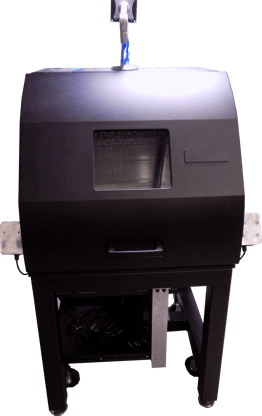
Ball Systems delivered a design and build solution for a sound chamber developed to support acoustic performance testing of centrifuges manufactured by Eppendorf, a leading provider of laboratory and life science equipment. Built to Eppendorf’s detailed technical specification, the chamber enables consistent and repeatable noise-level measurements during both product validation and quality assurance testing.
The project was defined as a turnkey effort, beginning with conceptual design and progressing through detailed design, prototyping, functional verification, and final delivery. Ball Systems supported the full program lifecycle through structured project milestones including kick-off, concept demonstration, prototyping and build, and program completion with final implementation in production.
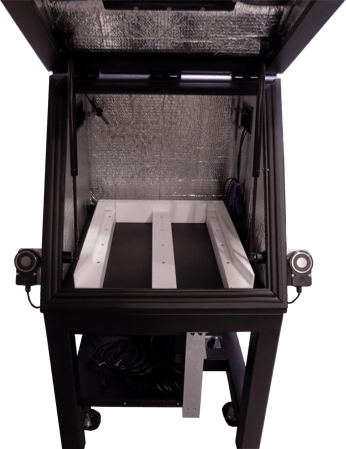
The sound chamber was engineered to support Eppendorf’s inline manufacturing workflow, where completed centrifuge units travel from an existing electrical and functional test station to the sound test system for acoustic evaluation. Operators scan a 2D Aztec barcode containing the unit serial number, model number, and lot number, then slide the centrifuge into the chamber on its existing production tray without complex adjustments or lifting. Once loaded, the system guides the operator to install the correct rotor, set the centrifuge speed to 15060 rpm, and initiate testing through an integrated user interface.
The chamber’s precision construction minimizes background interference while supporting repeatable test conditions that align with ISO 3745 acoustic measurement methodology. The system is designed to measure an average A-weighted sound value in dB(A), compare it against configurable minimum and maximum limits by centrifuge model, and automatically display a PASS or FAIL result to the operator. In addition to pass/fail evaluation, all historical test data is recorded into an SQL database within Eppendorf’s internal domain to support traceability, reporting, and long-term quality tracking
To ensure measurement fidelity, Eppendorf specified strict microphone and measurement performance requirements, including 0.1 dB(A)resolution, a frequency range from 3.15 Hz to 20 kHz, and a dynamic range from17 dB(A) to 138 dB(A), with overall system measurement uncertainty not exceeding 2%.
The chamber was also required to detect and warn operators if background noise exceeded acceptable limits, supporting reliable measurements even in active production environments.
The sound chamber uses a National Instruments CompactDAQ-based measurement and control system to ensure accurate, repeatable acoustic performance testing. At the center of this architecture is an NIcDAQ-9185, a four-slot Ethernet CompactDAQ chassis designed for industrial environments. This chassis acts as the system’s communication and data acquisition backbone, hosting modular I/O modules and streaming measurement data to the control PC over Ethernet. Its extended temperature rating and remote connectivity make it suitable for installation inside an enclosed test chamber or on the production floor, while maintaining the standalone architecture required by Eppendorf’s manufacturing infrastructure.
Installed in the chassis is an NI-9230 dynamic signal input module, which acquires high-fidelity waveform data from acoustic sensors and related instrumentation. With three BNC input channels and a ±30V measurement range, this module supports precise recording of sound pressure levels and vibration characteristics during centrifuge operation. Because acoustic testing depends on capturing rapidly changing signals, the NI-9230 is critical to delivering reliable and repeatable performance data.
For digital control and monitoring, the system uses NI-9472and NI-9421 modules. The NI-9472 provides eight channels of 6–30 VDC sourcing digital outputs to control external devices such as relays, indicators, and automated test equipment. This supports controlled test sequencing, including start/stop operations and automated chamber functions. Complementing this capability, the NI-9421 offers eight channels of sinking digital inputs to monitor discrete signals from sensors, lid position detection, safety interlocks, and equipment status outputs. These signals ensure the chamber only begins measurement after lid closure is confirmed and allows the test to abort automatically if the lid is opened during operation, as required by the specification.
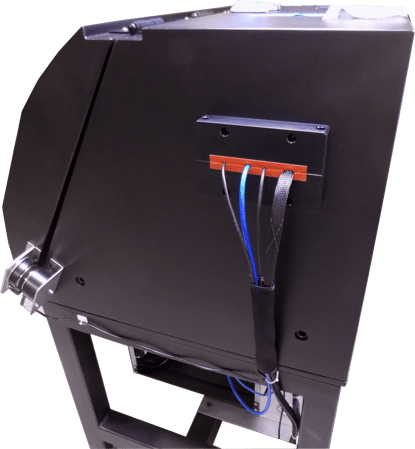
The CompactDAQ chassis is mounted on a DIN rail using an NI mounting kit, providing secure installation, orderly cable routing, and service-friendly access within the control panel. This supports Eppendorf’s requirement that electrical and mechanical components remain accessible for troubleshooting, replacement, calibration, and preventative maintenance.
Software and controls were also developed to meet Eppendorf’s framework requirements, including use of LabVIEW and .NET, support for barcode scanning using Zebra devices, and structured separation between the main test application and a standalone test data retrieval module. The system captures operator identification, time/date stamps, and batch information while automatically calculating statistical metrics such as Cp and Cpk for process capability monitoring.
To ensure compliance and long-term sustainability, Ball Systems supported Eppendorf’s documentation and validation expectations, including detailed design records, calibration protocols, preventative maintenance plans, risk analysis documentation, electrical interface diagrams, error message troubleshooting guides, and formal verification reports. Verification requirements included comparative acoustic testing between the Ball Systems-developed chamber and an ISO 3745-compliant anechoic sound room, with statistical analysis of deviation, variance, and accuracy used to confirm system performance
This project highlights how Ball Systems partners with global customers to deliver reliable test equipment and fixtures for specialized applications, combining precision mechanical design, comprehensive industrial controls, and scalable NI-based measurement systems to deliver repeatable production-ready test capability.

Ball Systems creates, develops, and delivers custom test systems and produces comprehensive build-to-print systems for companies that craft or manufacture critical electronic or electromechanical components for aerospace and defense, automotive, and consumer appliance applications.