
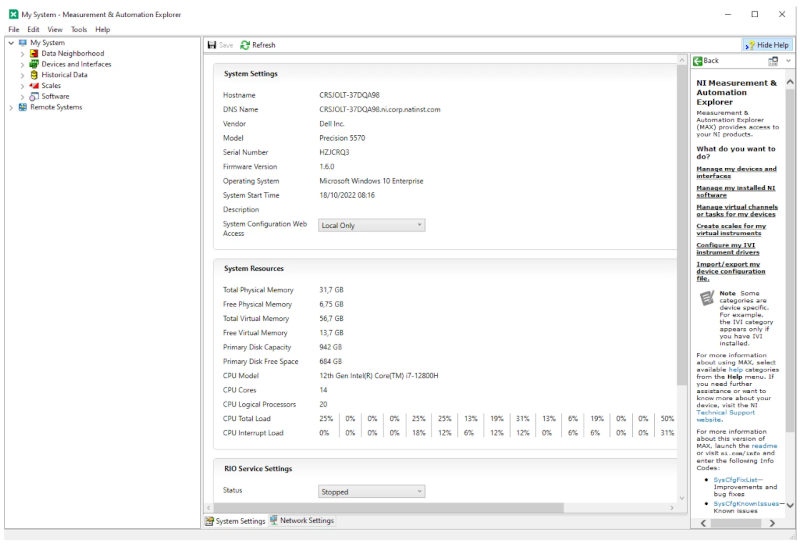
If you've ever opened one of our test cabinets, the first thing you probably noticed wasn't a tangle of one-off wiring. It was a chassis. A single, dense enclosure doing the work that used to take a bench full of separate boxes. That's the PXI platform, and it's the backbone of many of our custom test systems.
We get asked a lot of versions of the same question: why PXI and why does it matter to me as the customer?
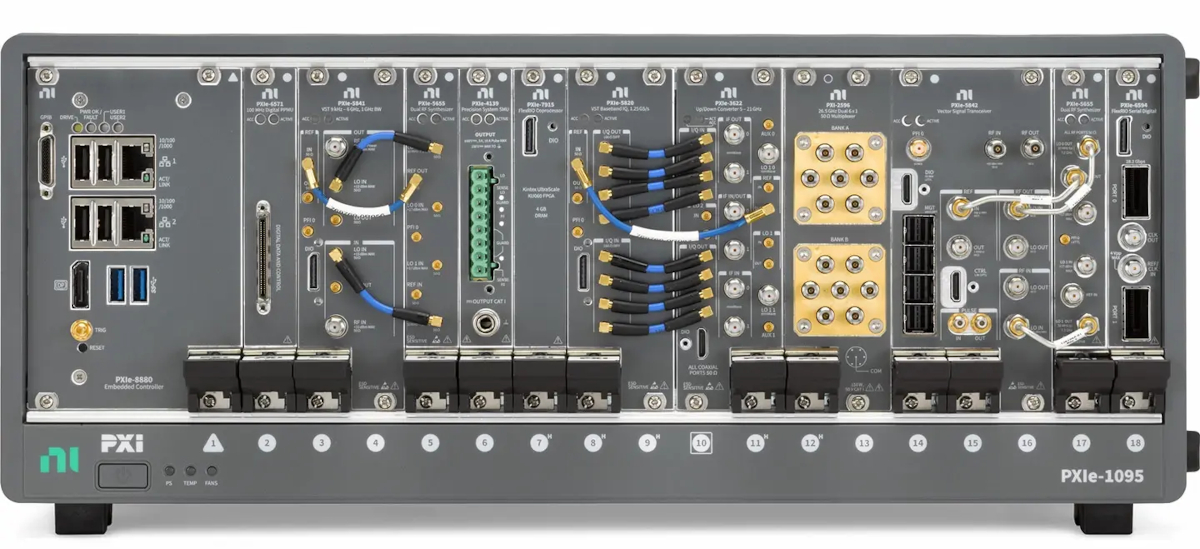
Strip away the acronym, and a PXI chassis is doing the same job a PC case and motherboard do for a desktop, just purpose-built for measurement and automation instead of general computing. It provides power, cooling, and a high-speed communication backplane, and it lets you slot in multiple instrumentation modules, including digitizers, DMMs, matrix relays, digital I/O, and RF modules inside one highly durable housing instead of a rack of standalone instruments.
Every chassis follows the same basic anatomy:
It's an open industry standard, developed in 1997 and governed by the PXI Systems Alliance since 1998, which is the part that matters most once you're the one who has to own the system for the next 10-15 years: modules from different manufacturers are built to talk to the same backplane, so you're not locked into a single vendor's roadmap to keep your tester alive.
We've been building PXI-based systems for aerospace, defense, and automotive programs for years. National Instruments (NI) -based test stands built on PXI, cDAQ, cRIO, and LabVIEW show up across a large share of our build-to-print work. A few real examples of how architecture flexes depending on the application:
Aerospace & Defense — PXI Card Sets and Calibration Systems
On the defense side, we've built custom NI-compatible PXI test systems used to calibrate military aircraft, along with legacy flight recorder test equipment and automated flight termination unit test systems — all leaning on the same chassis-and-module foundation.
Industrial & Heavy Equipment — Mixed Fixture Cabinets
A lot of what we build isn't several separate systems tied together. It's a single PXI chassis handling every piece of the DUT (data acquisition, signal conditioning, pneumatic or electrical actuation) through one backplane and controller. Keeping it to one chassis instead of several is simpler to manage, easier to synchronize, and reduces the hardware footprint we have to maintain.
Automotive — Dual-Controller ECU Production Testing
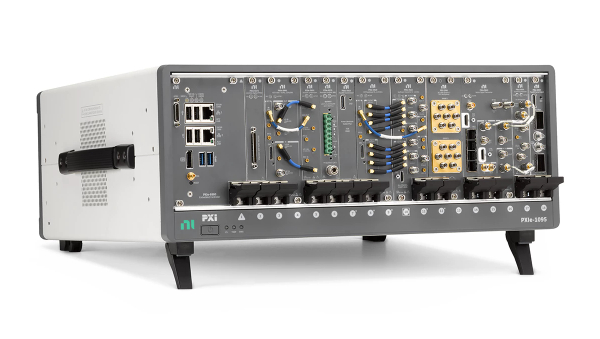
On a recent domain-controller ECU tester, the PXI chassis was loaded with DMM modules and a matrix relay that converts incoming signals into the digital I/O needed to drive a set of pneumatic controllers and read back proximity switches on the fixture. A VPC receiver on the front of the cabinet handled the physical interface between the chassis and the fixture — the layer that actually touches the product under test.
That system ran dual controllers so it could test two ECUs simultaneously, mirrored hardware on the left and right side, doubling throughput without doubling the footprint. It was also built to be robotics-ready for an automated production line, and when requirements shifted mid-build — as they tend to on real programs — the architecture flexed without a full redesign. That's the practical payoff of PXI's modularity: you're not re-engineering the electrical architecture to add capacity or accommodate a late change; you're adding slots and modules to a backplane that was built to scale.
Across all three, the pattern holds: the chassis and module selection change to fit the product, the industry, and the compliance requirements, but the underlying discipline — modular, documented, serviceable — doesn't.
A few things matter to us more than they seem to matter to some integrators, and they all come back to the same idea: we're not just shipping a rig, we're handing you something you'll own for a decade or more.
A PXI chassis is a deceptively simple piece of hardware — a rugged enclosure with a fast backplane — but the way it's configured is where a test system either becomes a long-term asset or a science project nobody wants to touch in five years. We've been architecting these systems for six decades of manufacturing partners across automotive, aerospace, and defense, and the chassis is where most of that discipline shows up first: in the layout, the module selection, and the documentation that lets someone besides us keep it running.
If you're scoping a new PXI-based tester or trying to figure out what's actually inside the cabinet you inherited from another vendor, that's a conversation we're always glad to have.

Ball Systems creates, develops, and delivers custom test systems and produces comprehensive build-to-print systems for companies that craft or manufacture critical electronic or electromechanical components for aerospace and defense, automotive, and consumer appliance applications.






Blog Comments