

Product development cycles are moving faster than ever, particularly in industries like aerospace, defense, commercial aviation, automotive, and consumer appliances. As system complexity increases, engineering teams rely more heavily on a rigorous testing framework to validate performance, reduce risk, and accelerate time‑to‑market.
Below is a comprehensive look at the three core testing phases: Engineering Validation Testing (EVT), Design Validation Testing (DVT), and Production Validation Testing (PVT).
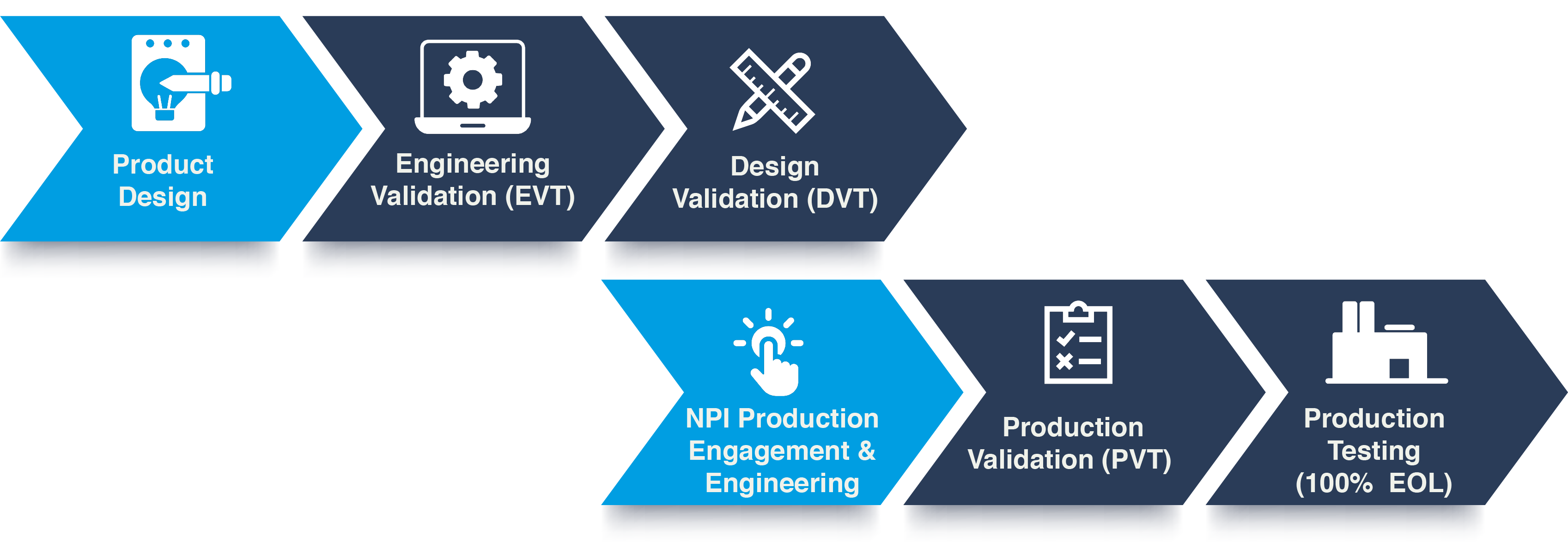
Navy Blue = Functional areas where testing is developed and utilized
The testing needs of each are highly differentiated as a result.
The question EVT answers: Does the design actually work?
EVT is the first formal checkpoint after concept and early prototyping. It's owned primarily by design and R&D engineering, with test engineering brought in to build early fixtures and characterization setups. The goal isn't polish — it's finding out fast whether the fundamental architecture is sound before anyone commits to tooling.
Typical activities:
What EVT catches: Fundamental design flaws, incorrect component selection, firmware/hardware interface mismatches, and architecture-level risks. Catching a problem here might cost a redesign of a PCB layout; catching the same problem in DVT could mean re-cutting a tool, and in PVT it could mean a line stoppage.
Typical duration: Weeks, not months — EVT is meant to move fast and iterate.
Common failure point: Teams sometimes treat EVT results as "close enough" and push straight into DVT tooling decisions before firmware and hardware have actually stabilized, which just moves the same bugs downstream at higher cost.
The question DVT answers: Does it meet specifications and compliance requirements?
DVT is where the design has to prove itself against real performance, durability, and regulatory targets — not just "does it function," but "does it function within spec, over its full environmental range, for its full expected life." This is typically where dedicated test engineering takes the lead, often building semi-automated or fully automated test systems for the first time.
Typical activities:
What DVT catches: Marginal designs that work in the lab but fail under thermal cycling, vibration, or long-term use; compliance gaps that would otherwise surface during formal certification (an expensive place to find them); and integration issues that only appear when subsystems interact.
Typical duration: Often the longest phase — one to several months, depending on regulatory scope (aerospace and automotive DVT cycles run longer than consumer electronics).
Common failure point: Building one-off manual test fixtures instead of automated test systems. It works for a small DVT sample, but it doesn't scale, isn't repeatable across engineers, and gets thrown away rather than reused in PVT — a missed opportunity discussed further below
The question PVT answers: Can we build it repeatedly and reliably, at volume?
PVT shifts ownership to manufacturing and quality engineering. The design is presumed correct at this point — the question is whether the process is capable of producing it consistently, at yield, at cost.
Typical activities:
What PVT catches: Process-induced defects that never showed up in DVT because DVT used hand-built units — solder issues from a new reflow profile, fixture wear, operator-dependent variation, and yield-limiting steps that need process changes, not design changes.
Typical duration: Runs in parallel with production ramp; sample sizes are much larger (dozens to hundreds of units) since the goal is statistical confidence in the process, not just the design.
Common failure point: Discovering during PVT that the DVT test system can't be reused or scaled for production volume, forcing teams to build a second, incompatible test system from scratch.

Download our white paper, Leveraging Common Test Platforms Across The Product Lifecycle, to learn how to use common test platforms to optimize testing strategies across multiple departments:


Ball Systems creates, develops, and delivers custom test systems and produces comprehensive build-to-print systems for companies that craft or manufacture critical electronic or electromechanical components for aerospace and defense, automotive, and consumer appliance applications.




Blog Comments