

The next time you board a flight, watch the crew walk down the jet bridge. Most of what they carry is exactly what it looks like — flight bags, manuals, maybe a coffee.
But occasionally you’ll see a small, unassuming case moving along with them. It doesn’t draw attention. The crew doesn’t treat it as anything out of the ordinary.
Because to them, it isn’t.
Inside that case is a piece of aerospace ground support equipment that most travelers will never see or think about — and that’s the point. It’s designed to disappear into the rhythm of normal operations, until the moment something isn’t normal. Then it becomes one of the more important tools on the ramp.
That case is called an Extended Handheld Download Unit, or EHHDLU, and Ball Systems has been building them for years.
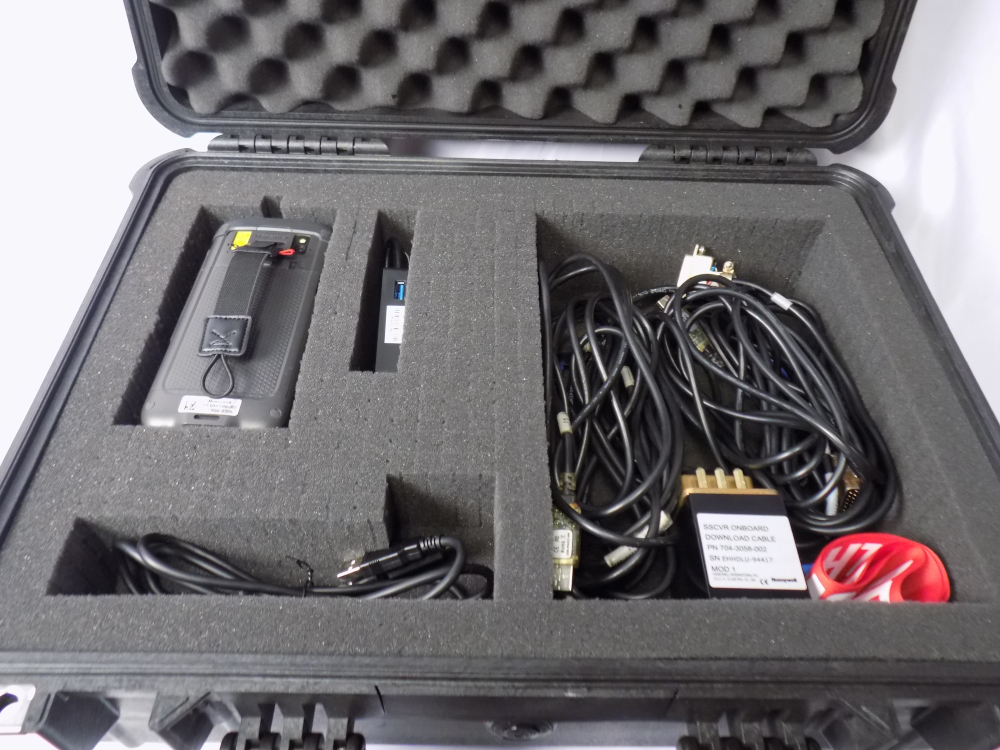
The Extended Handheld Download Unit (EHHDLU) is a portable, field-deployable aerospace ground support equipment (GSE) kit used by commercial aviation and defense operators to access, download, and work with onboard aircraft data during unscheduled maintenance events, Aircraft on Ground (AOG) conditions, and routine service actions. Ball Systems manufactures the EHHDLU under a long-running build-to-print program for the avionics OEM, which specifies the kit and covers hundreds of unique GSE part numbers across a wide array of aircraft subsystems.
Each EHHDLU kit integrates an aircraft-specific interface device supplied by the avionics manufacturer, along with a defined set of specialized tools and supporting hardware, packaged in a transportable case for flight-line and line-maintenance use. Kits are configured per subsystem, produced to the OEM’s drawing package, tested against documented acceptance criteria before shipment, and distributed both domestically and internationally to wherever the supported fleet operates.
EHHDLU kits are used at the interface between the aircraft and the maintenance technician. Typical applications include:
Because EHHDLU kits are used in operational environments rather than on a bench, the functional threshold is pass/fail at the point of use. Kits that do not perform correctly on first use can extend AOG duration, delay data retrieval for compliance review, or force a fallback to a non-standard process. The program’s specification, build, and test controls are structured around that reality.
The EHHDLU is a build-to-print program: the OEM owns the design, configuration, and specification; Ball Systems manufactures, integrates, tests, and ships the kits. The execution model has four technical elements.
Each EHHDLU configuration is produced against an OEM-supplied drawing package that defines the bill of materials, the interface device, cabling, supporting tools, case layout, markings, and documentation set. Configuration identity is maintained per part number — hundreds of unique GSE part numbers are in active production across the program to support different aircraft subsystems. When a drawing package contains missing, ambiguous, or conflicting information, the issue is flagged and resolved with the customer through formal communication channels before the build proceeds. Resolutions are documented against the applicable revision.
Build activity draws on the same assembly capabilities used across Ball Systems’ aerospace portfolio:
Assembly is performed by technicians with certifications and years of experience in aerospace-class electronic assembly. The same people interpret the drawing package, identify specification gaps during the build, and escalate issues before they propagate downstream.
Every EHHDLU unit is functionally tested against the customer’s acceptance criteria before it is released for shipment. Test coverage includes interface device operation, cable continuity and pinout verification, kit-level integration checks, and any subsystem-specific functional test defined in the acceptance procedure. A unit that does not pass the acceptance procedure is not released; the failure is investigated, corrected, and the unit is retested against the full procedure.
Shipment documentation, export controls, and packaging specifications are handled as part of the deliverable. EHHDLU kits ship both domestically and to international operator locations under the applicable export control and customer shipping requirements.
The EHHDLU program operates under Ball Systems’ standard quality and compliance framework for regulated aerospace manufacturing:
For program-level execution, the applied controls include single-point-of-contact technical engagement (one assigned engineer per program), weekly status communication with an open-issues log, and defined change-impact communication within one week of a customer-originated change request.
The EHHDLU is one of several aerospace build-to-print and test system programs Ball Systems supports. Adjacent capabilities that frequently appear in related RFQs and scopes include:
Customers supported across these programs include Boeing, Honeywell, Collins Aerospace, Crane Aero, Rolls-Royce, General Dynamics, L3Harris, the U.S. Air Force, and the U.S. Navy.
See the Full List>
Technical inquiries related to EHHDLU configurations, adjacent aerospace ground support equipment programs, or other build-to-print aerospace test system work can be directed to us.


Ball Systems creates, develops, and delivers custom test systems and produces comprehensive build-to-print systems for companies that craft or manufacture critical electronic or electromechanical components for aerospace and defense, automotive, and consumer appliance applications.





Blog Comments